
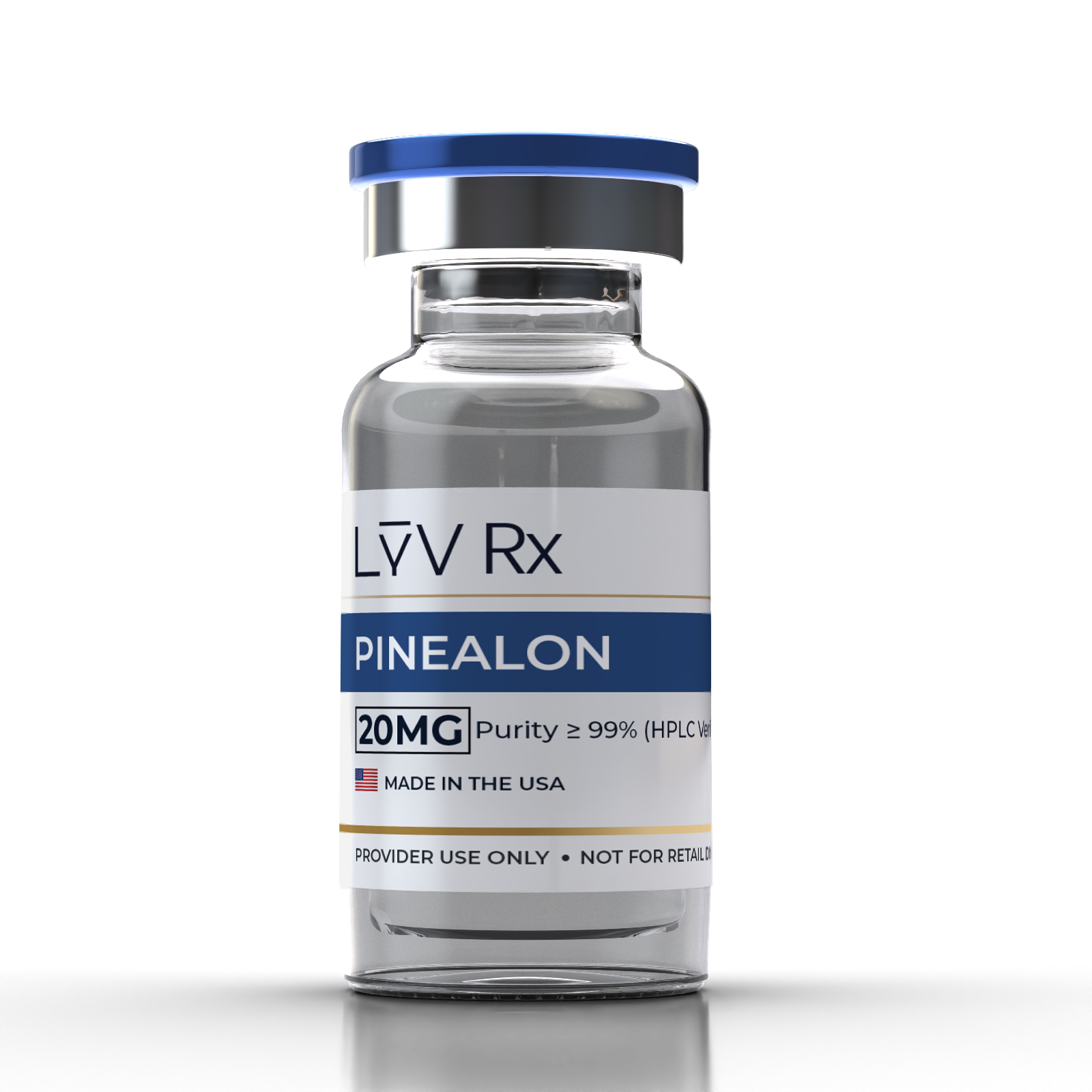
Pinealon
$84.99 — or $76.49 / month
Pinealon is a synthetic tripeptide modeled after pineal gland extract sequences and is used to investigate neuroendocrine regulation and oxidative stress responses.
Only 10 left in stock
Origin & Classification
Pinealon is a tripeptide with the sequence Glu-Asp-Arg, designed to replicate fragments found in extracts of the pineal gland. It belongs to the family of peptide bioregulators and is synthesized via solid-phase peptide synthesis. The peptide is not glycosylated and is considered a simple linear chain.
Mechanism & Research Context
The pineal gland orchestrates circadian rhythms and hormone secretion through melatonin production and interaction with the hypothalamic-pituitary axis. Pinealon is used in research to explore how short peptides influence neuronal activity, gene expression, and antioxidant defenses. Studies investigate its impact on melatonin synthesis pathways, regulation of neurotrophic factors, and modulation of oxidative stress response mechanisms involving superoxide dismutase and glutathione peroxidase. Researchers also examine potential effects on mitochondrial membrane potential, apoptosis-regulating proteins, and synaptic plasticity. The peptide serves as a tool to study the relationship between peptide signaling and neuroendocrine function.
Composition & Quality
Pinealon is supplied as a lyophilized peptide with purity typically greater than 95 % as determined by reverse-phase HPLC. It is synthesized under GMP-aligned conditions, with quality control including mass spectrometry for identity confirmation and endotoxin testing. Stability data support storage at low temperature in desiccated form, and reconstitution should occur in sterile aqueous buffers. Certificates of analysis accompany each batch, providing details on sequence, purity, and recommended handling.
Summary & Unified Disclaimer
This description summarizes the scientific context of the molecule. It is provided for educational and research discussion purposes only. It is not intended to diagnose, treat, cure, or prevent any disease, and no medical or consumption claims are made.
| Weight | 0.05 lbs |
|---|---|
| Dimensions | 1 × 1 × 2 in |
How Lyv Rx Works
Place Your Order
Enjoy our simple and secure shopping experience
Get medical approval
Our licensed physicians review every order placed
Optimize your health
Each order is shipped same-day to keep you moving
Reviews
There are no reviews yet.