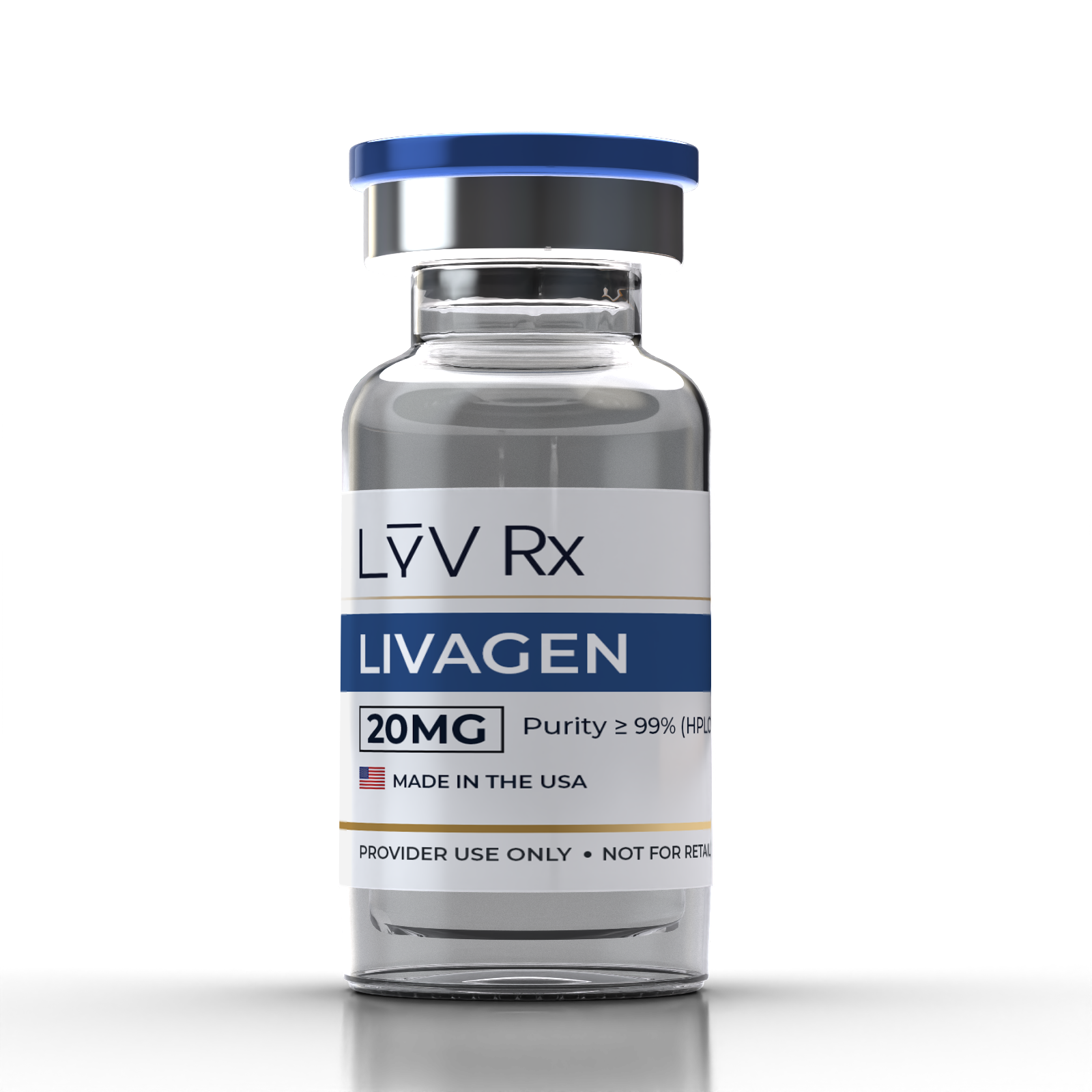
Livagen
$96.99 — or $87.29 / month
Livagen is a peptide bioregulator derived from liver tissue peptide fragments and is studied for its influence on hepatic gene expression and metabolic regulation.
In stock
Origin & Classification
Livagen is a peptide formulation comprising short amino acid sequences derived from regulatory regions of liver-specific proteins. These peptides are synthesized chemically using solid-phase peptide synthesis to mimic motifs that modulate gene expression in hepatocytes. The formulation belongs to the class of tissue-specific peptide bioregulators, often referred to as cytomedins, which are designed to investigate organ-specific regulatory mechanisms.
Mechanism & Research Context
Research on Livagen focuses on its potential to modulate gene transcription and protein synthesis in hepatic cells. The peptides are thought to interact with chromatin structures or transcription factors, influencing pathways involved in detoxification, gluconeogenesis, lipid metabolism, and protein synthesis. Studies explore effects on regulatory networks such as Nrf2/ARE, PPARalpha/gamma, and SREBP-1c, as well as cross-talk with inflammatory and oxidative stress pathways. By examining changes in gene expression profiles and metabolic enzyme activity, scientists gain insight into hepatic adaptation to dietary and hormonal changes. Livagen is used as a tool to dissect systems-level responses in the liver without suggesting clinical applications.
Composition & Quality
Livagen is supplied as a lyophilized powder composed of defined peptide sequences, each purified to a high degree (>95 %) by preparative HPLC. Production adheres to GMP-aligned standards, with quality control including mass spectrometry for identity confirmation, amino acid analysis, sterility testing, and endotoxin measurement. Stability studies support long-term storage in desiccated conditions at low temperature, and reconstitution in sterile aqueous buffers is recommended for experimental use. Certificates of analysis accompany each batch, detailing sequence, purity, and analytical data.
Summary & Unified Disclaimer
This description summarizes the scientific context of the molecule. It is provided for educational and research discussion purposes only. It is not intended to diagnose, treat, cure, or prevent any disease, and no medical or consumption claims are made.
| Weight | 0.05 lbs |
|---|---|
| Dimensions | 1 × 1 × 2 in |
How Lyv Rx Works
Place Your Order
Enjoy our simple and secure shopping experience
Get medical approval
Our licensed physicians review every order placed
Optimize your health
Each order is shipped same-day to keep you moving
Reviews
There are no reviews yet.