
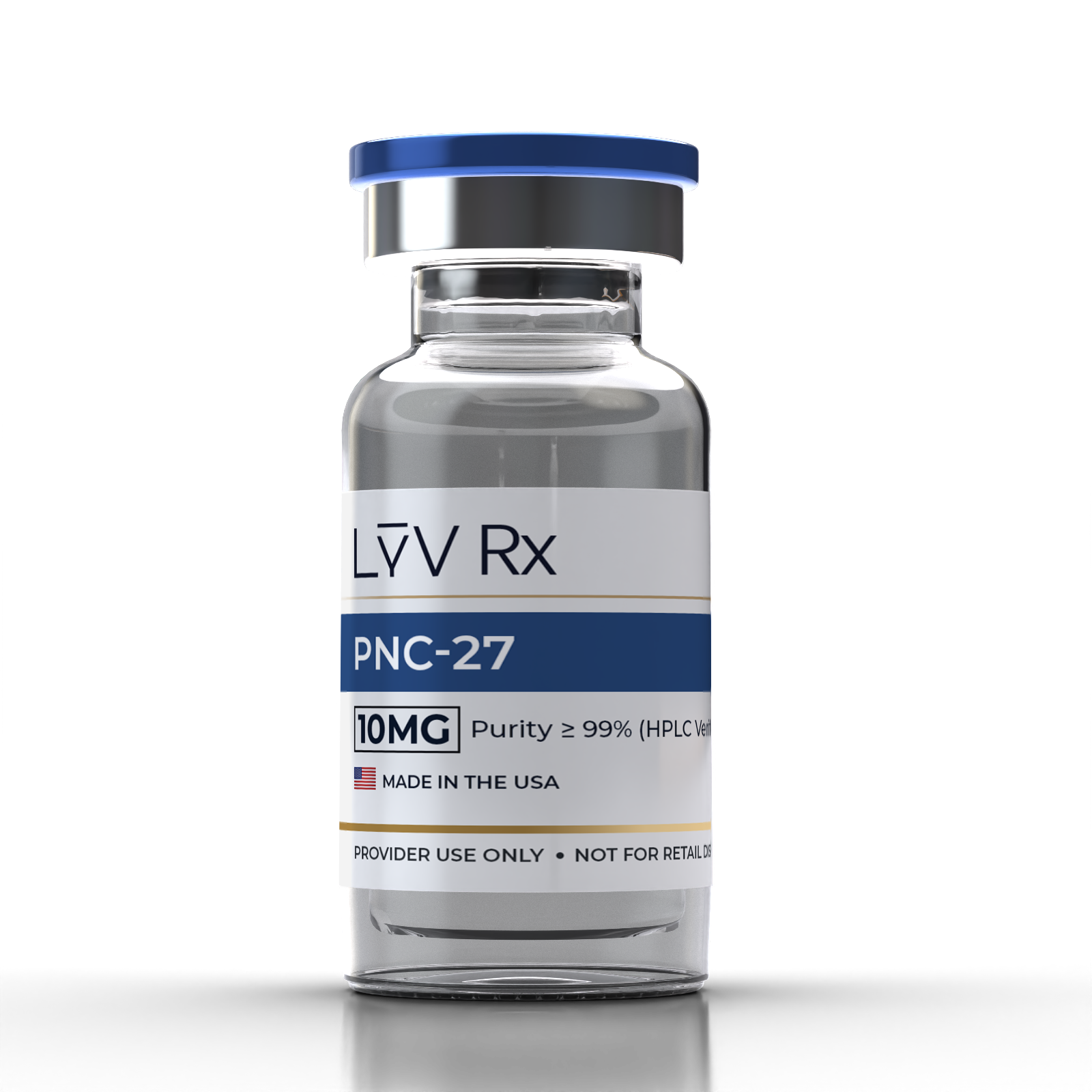
PNC-27
$129.99 — or $116.99 / month
PNC-27 is a synthetic peptide containing the MDM2-binding domain of p53 fused to a cell-penetrating sequence and is studied for its role in exploring cell death signaling and tumor biology.
In stock
Origin & Classification
PNC-27 is a synthetic peptide constructed by fusing a 14-amino-acid segment derived from the p53 tumor suppressor protein’s MDM2-binding region to a 13-amino-acid membrane-translocating peptide known as the penetratin sequence. The resulting 27-amino-acid fusion peptide is designed to enter cells and interact with MDM2, an E3 ubiquitin ligase that regulates p53 degradation. PNC-27 is produced via solid-phase peptide synthesis and belongs to the class of cell-penetrating peptides with targeted protein interaction domains.
Mechanism & Research Context
PNC-27 is utilized by researchers to study mechanisms of cell death and tumor cell biology. The peptide’s p53 segment binds to MDM2, potentially liberating endogenous p53 from negative regulation and activating p53-dependent transcriptional programs leading to apoptosis. The penetratin moiety facilitates cellular uptake. Studies examine how PNC-27 triggers mitochondrial outer membrane permeabilization, caspase activation, and Bax/Bak-mediated apoptotic pathways. Researchers also explore selective interactions with cancer cell membranes and examine the role of cancer-specific p53 mutations in modulating peptide activity. Through these investigations, PNC-27 serves as a tool for understanding p53-MDM2 interactions and cell death signaling in oncology research.
Composition & Quality
PNC-27 is supplied as a lyophilized peptide with a purity typically above 95 % as confirmed by HPLC and mass spectrometry. Production follows GMP-aligned procedures, and quality control includes verification of both the penetratin and p53-derived segments, peptide content determination, and endotoxin testing. The peptide is stable under desiccated conditions and low temperature. Reconstitution in sterile aqueous buffers should be performed immediately before use. Certificates of analysis provide details on sequence, purity, and recommended storage conditions.
Summary & Unified Disclaimer
This description summarizes the scientific context of the molecule. It is provided for educational and research discussion purposes only. It is not intended to diagnose, treat, cure, or prevent any disease, and no medical or consumption claims are made.
| Weight | 0.05 lbs |
|---|---|
| Dimensions | 1 × 1 × 2 in |
How Lyv Rx Works
Place Your Order
Enjoy our simple and secure shopping experience
Get medical approval
Our licensed physicians review every order placed
Optimize your health
Each order is shipped same-day to keep you moving
Reviews
There are no reviews yet.